Disclaimer: The views and reflections shared here are entirely my own and do not represent those of my employer, Broadcom, or any affiliated partners.
Once Upon a Datacenter: The Unicorn and the Giant
Once upon a time, in the heart of every datacenter, there lived a unicorn named VMware. It wasn’t just another creature of code, it was the quiet magic that made machines dance and businesses dream.
But even unicorns built on silicon can’t stay wild forever. One day, a giant from the semiconductor mountains, Broadcom, brought it into its stable. The industry froze, torn between fear and hope: would the magic fade, or would the beast finally mature?
Now that the storm of emotion has passed, we can look at it for what it truly was. I was there, on the partner side, watching from the field as the landscape shifted, as some allies were lifted up… and others quietly left behind.
Two years later, the myth has changed. The unicorn stands taller, wiser, forged by pressure and pragmatism. But as it sharpens its horn and gazes at the horizon, one can’t help but wonder: is this still the same creature we once believed in?
From Fairy Dust to Fiscal Discipline
When Broadcom closed its $61 billion acquisition of VMware in November 2023, the IT world trembled. VMware, once the industry’s virtualization unicorn, born from engineering brilliance and open community, was suddenly under Broadcom’s command. The company known for spreadsheets and profit margins had just bought one of tech’s most beloved innovators.
Broadcom wasted no time. VMware’s hundreds of SKUs collapsed into a handful of bundles. Perpetual licenses vanished overnight, replaced by mandatory multi-year subscriptions. The new VMware spoke one language: VMware Cloud Foundation, the full suite combining vSphere, vSAN, NSX, and Aria.
Then came the cuts. VMware’s headcount dropped from roughly 38 000 to 16 000 employees (The Register, 2024). Entire divisions disappeared: End-User Computing spun off as Omnissa, Carbon Black was sold, and internal R&D labs shuttered.
Sticker Shock and the Subscription Squeeze
Within months, customers began reporting price shocks. Social media screamed: “VMware just got 10× more expensive!”, a claim that, while not baseless, oversimplified reality.
Independent analyses by CISPE and TechRadar show real-world increases between +150% and +400% on average, and up to +1000% in extreme, minimal-license cases (TechRadar, 2025).
Toshiba moved 2200 VMs to Nutanix after seeing its renewal jump roughly 10× (CRN Japan, 2025). MSIG Insurance in Asia reported a 300–400% increase and walked away after 15 years.
Yet larger enterprises with multi-product environments negotiated better terms. Some secured flat renewals or even 30% lower total costs through strategic Enterprise Agreements (CRN Germany, 2025).
The math was brutal but logical: smaller customers were expendable, big ones funded the future. VMware’s revenue now flows through Broadcom’s Infrastructure Software segment, which reached $6.6 billion in Q2 FY2025 and $6.8 billion in Q3, up about 17% year-over-year (CRN, 2025, Techstrong IT, 2025
).
How VMware Compares: Subscriptions Everywhere, Not Just at Broadcom
The irony is that VMware was one of the last major software companies still selling perpetual licenses. The rest of the industry made this shift years earlier, quietly.
Nutanix
Nutanix’s Nutanix Cloud Infrastructure (NCI) is sold entirely on 1–5-year term subscriptions per physical CPU core. Add-ons like Nutanix Unified Storage and Database Service follow the same model. Even NC2, its public-cloud extension, is subscription-only, pay-as-you-go or BYOL (Nutanix Software Options, Nutanix Cloud Clusters Pricing).
Red Hat
Red Hat never offered perpetuals. Its entire value equation has always been subscription + support.
- RHEL Standard starts around $295/year per server; add-ons like Satellite ($1 263/year) and HA ($438/year) are extra.
- OpenShift pricing is listed hourly or annually, roughly $0.07/hour for 4 vCPUs or per-core annual terms (Red Hat Store, OpenShift Pricing).
The Reality
Everyone now sells subscriptions. VMware’s shift just came late, and... loud. Where Broadcom differed was in bundling: Nutanix and Red Hat allow modular buys, while Broadcom made full-stack commitment mandatory.
So yes, the unicorn grew horns, but it’s sharing the meadow with plenty of other horned beasts.
Technical Evolution: Less Sparkle, More Substance
Despite layoffs and consolidation, VMware’s engineering didn’t die; it re-focused. Broadcom’s acquisition didn’t slow engineering, it re-architected it. VMware moved from scattered brilliance to industrial precision.
Key technical shifts
- VCF 9 = one platform. Unified lifecycle, security, and deployment. No more fragmented product stacks; vSphere, vSAN, and NSX now evolve together.
- Image-based lifecycle only. vSphere 9/VCF 9 removed baselines; vLCM Images are mandatory. Desired-state, firmware-aware, consistent, fewer snowflake clusters.
- Hardware-agnostic workflows. Standardized APIs and lifecycle across Dell, HPE, Lenovo — no more VxRail-only logic.
- VCF-first innovation. vSphere 9 and vSAN 9 are built for VCF 9 -> not the other way around.
Why this matters
- Faster delivery: one codebase, fewer forks; innovation ships once, works everywhere.
- Higher reliability: composable images replace manual patching chaos.
- Simpler upgrades: designed lifecycle sequencing from management domain down, not “best effort” projects.
Even VxRail.next follows the same model: it’s no longer a custom branch but an integrated VCF persona, bringing Dell back into the same engineering flow (read ou article for more info on VxRail's future).
In short , Broadcom turned VMware from a toolkit into a platform factory. Less glitter, more gravity. But the result is a cleaner, faster, and more predictable innovation engine.
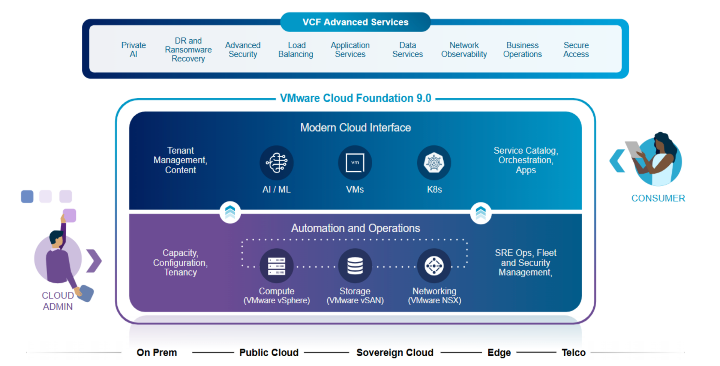
Fewer products, slower cadence, but higher reliability. VMware’s wild innovation days are gone, replaced by steady iteration. It’s less magic lab, more industrial factory. And for critical infrastructure, that’s not a bad trade.
Partners and the Purge
Broadcom’s rationalization hit the partner ecosystem hardest. Thousands of resellers lost accreditation. Only those selling the full VCF stack remained in the Premier Tier.
Cloud Service Providers faced new minimum commitments of 3 500 CPU cores. Smaller hosts, Anexia, OpenNebula, even Rackspace, dropped VMware altogether. CISPE filed complaints with the EU Commission, alleging anti-competitive behavior.
The result? Fewer partners, larger deals, higher barriers, exactly Broadcom’s design.
From Community to Corporation and... back again
At first, it felt like the community lost its soul. VMware had always been more than a company, it was a tribe. Engineers, vExperts, VMUG leaders, and enthusiasts built something that no marketing budget could buy: trust and passion. When Broadcom arrived, that energy dimmed.
But communities are resilient. And Broadcom, to its credit, eventually realized that this collective spirit wasn’t a side effect, it was part of VMware’s core value. The company began to rebuild its ecosystem through a different lens: fewer fireworks, more focus.
That’s where the Broadcom Knights program appeared, an invitation-only initiative recognizing elite partner technologists certified on VMware by Broadcom solutions, particularly VCF.
Among its early members are engineers from ITQ, a long-time VMware partner known for its deep technical culture and vExpert heritage (ITQ).
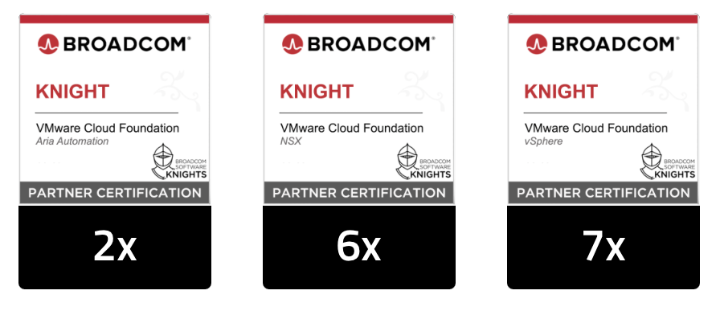
It’s a more curated community; smaller, sharper, and closer to the field. The vibe has changed, but the passion has not.
Two Years Later: The Horns Hold
Two years on, VMware stands transformed, leaner, sharper, and thriving with a newfound purpose.
The platform remains the backbone of enterprise virtualization, anchoring the world’s most critical workloads. Some customers explored new horizons with Nutanix or cloud-native alternatives, yet most stayed , not out of inertia, but because the foundation held. Stability, consistency, and performance still matter, and VMware continues to deliver all three.
VMware today is no longer the playful unicorn of old; it’s a seasoned creature that has embraced structure without losing its soul. Under Broadcom, it found direction, fewer products, clearer focus, faster execution. The engineering cadence is tighter, the portfolio cleaner, and the ambition higher than it has been in years.
For those of us who once lived under its rainbow, the change felt harsh at first. But looking closer, the colors didn’t vanish, they matured. The magic evolved into discipline, and the dream found a blueprint.
The unicorn didn’t just survive the storm; it learned to run faster in the rain. It grew up, got a haircut, and found a new kind of strength under Broadcom’s rule , with shorter hair, sharper horns, and its eyes firmly set on the future.